Buying Guide · 2026

Best Racing, Cruiser & Winter Motorcycle Gloves: 2026 Buyer's Guide

A great motorcycle glove solves three problems at once: it protects the knuckle from a direct impact, it lets the palm skip across pavement instead of catching, and it disappears on the handlebars so you stop thinking about it three minutes into the ride. Different riding styles demand different gloves. Racing sport gloves prioritize pre-curved fingers and hard knuckle armor over breathability. Cruiser gloves reverse those priorities — long gauntlet cuffs, warmer construction, less aggressive armor. Winter and waterproof gloves add a membrane layer for wet and cold weather. This guide focuses on the racing, cruiser, and winter/waterproof categories — what's actually worth buying in 2026, what's the right spend, and which gloves fit how you actually ride.

Updated July 2026 · 5 gloves reviewed · 3 categories covered

Motorcycle Glove Protection Ratings Explained

Every motorcycle glove falls into one of two categories: CE-certified to EN 13594, or not. CE EN 13594 is the independent European motorcycle glove standard — four protection levels, with Level 1 (knuckle) and Level 2 (knuckle plus reinforced palm) being the two that matter for street riding. Understanding what the certification actually tests tells you which glove to trust and which glove is theater. A glove without CE marking cleared no independent test at all. The same logic applies to jacket armor and helmet certifications — match the level across the kit so one piece isn't the weak link.

Certification Standards & Glove Anatomy at a Glance

CE EN 13594 Level 1 Knuckle-only certification. Independent lab-tested impact resistance. The minimum for street riding — fine for short commutes, doesn't cover palm abrasion.
CE EN 13594 Level 2 Knuckle + reinforced palm. Stronger palm abrasion and tear resistance. The standard for high-mileage touring and aggressive street riding.
EN 13594:2015 Update 2015 revision added palm slider testing, knuckle dimension spec, and pH/chemistry limits on leather. Look for "EN 13594:2015" not older pre-2015 standards.
Knuckle Armor Hard plastic or carbon-fiber shell over the knuckles. TPU is the most common. Should not create a pressure point when gripping the bars.
Palm Slider Internal slider on the palm that lets the glove skip across pavement instead of catching. Often hidden under the palm leather — visible on race-cut gloves.
Membrane (Gore-Tex / Hipora) Waterproof layer laminated between outer shell and inner liner. Gore-Tex breathes best and costs most. Hipora is mid-tier. Single-layer = warmer; two-layer = swappable.

Also see: Helmet Buying Guide · Boot Buying Guide · Jacket Buying Guide

Best Racing Gloves

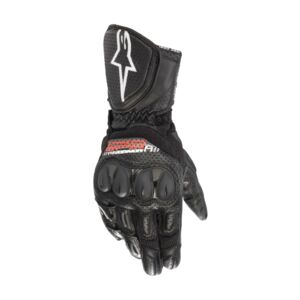
Racing sport gloves are tooled around the closed-fist grip position. Fingers are pre-curved so the glove is already shaped like the way you hold the bars. Knuckle armor is hard plastic or carbon fiber, sized to clear the bar without biting into the palm seam. Palm sliders are external — visible hardware that lets the glove skip across pavement in a slide. The Alpinestars SP-8 V3 is the street sport benchmark we keep coming back to — Clarino synthetic leather palm, hard plastic knuckle, internal palm slider, and CE EN 13594 Level 1 at a price point that doesn't require a long conversation with yourself. It's not a track-only glove, but it's built with track glove sensibilities.

Alpinestars SP-8 V3 street sport motorcycle gloves — CE EN 13594 Level 1, hard knuckle armor, palm slider
Racing Pick

Alpinestars SP-8 V3

The glove Alpinestars puts on riders who want genuine protection without the bulk of a race glove. Clarino synthetic leather on the palm and fingers wears harder than natural leather and feels broken-in from day one. Hard plastic knuckle protector. Internal palm slider. TPU reinforcements over the fingers and thumb. Breathable mesh inserts keep your hands from soaking through on a summer commute. CE EN 13594 Level 1 certified. The glove you leave in your jacket pocket permanently because it fits and it works.

Also see: Women's Gear Guide · All Riding Gear

Best Cruiser Gloves

Cruiser gloves are built around the long-mile highway ride, not the closed-fist sport position. The cuff is a gauntlet — long enough to tuck under jacket sleeves and seal out rain and wind at the wrist. Construction is warmer because cruiser riders do more cold-weather cruising than sport riders. Protection is conserved — knuckle armor, palm reinforcement, reinforced seams — but the glove is sized and shaped for upright posture, not race tuck. The Held Phantom II is the cruiser-riding sweet spot we keep recommending — kangaroo leather palm, AKIRA hard knuckle, internal palm slider, and the kind of fit that disappears on the bars after ten miles. Made in Germany since 1946, which matters for the leather quality control you can't fake.

Held Phantom II cruiser motorcycle gloves — kangaroo leather palm, AKIRA knuckle protector, palm slider
Cruiser Pick

Held Phantom II

Held has been making motorcycle gloves in Germany since 1946 and the Phantom II is why people still pay attention. The palm and fingers are cut from kangaroo leather — lighter, stronger, and more supple than cowhide at equivalent thickness. The AKIRA hard protector sits over the knuckles without creating pressure points. Internal palm slider. Pre-curved fingers mean no break-in period. Elastic cuff closes fast and stays put. Available in women's sizing. If you care about what's between your hands and the asphalt, this is the honest answer.

Also see: Helmet Buying Guide · Full Gloves Guide

Best Winter & Waterproof Gloves

A winter/waterproof glove solves two problems that don't exist in summer riding: cold hands at highway speed, and soaked-through gloves in rain. The solution is a waterproof membrane — Gore-Tex or Hipora — laminated between the outer shell and the inner liner. The membrane is what separates a cold-weather glove from a regular glove, and the membrane tech is what separates a good cold-weather glove from a soaked-through one. A glove that doesn't fully waterproof is no better than a glove you didn't bother wearing — wet hands lose dexterity, and dexterity is the whole point of gloves in the first place. Double-layer membrane systems let you swap the membrane out for warm dry weather.

Held Phantom II winter glove with Hipora membrane — waterproof cruiser motorcycle glove, all-season
Winter Pick

Held Phantom II (Hipora Lined)

The all-season version of the Held Phantom II retains the kangaroo-leather palm and AKIRA hard knuckle but adds a Hipora waterproof membrane behind the shell. The membrane keeps water out and warmth in without the dead-hand feeling of a single-layer waterproof glove. Hipora is mid-tier waterproofing — functional, slightly less breathable than Gore-Tex, and the right answer for cruiser riders who tour year-round in mixed weather. Cuff closes fast over a jacket sleeve. CE EN 13594 Level 1 certified.

Also see: Winter Jackets Guide · All Riding Gear

How to Measure for Motorcycle Gloves

A glove that's too tight at the seams won't protect your hand in a slide — it'll tear open at the stitch line. A glove that's too loose will gap at the fingertips where the armor needs to sit. Fit is the first safety specification, not the last. These benchmarks apply across every brand we carry. Once you've got the right glove, complete the kit with a certified helmet, armored jacket, and protective boots.

How to Measure

Wrap a soft tape measure around the dominant hand at the widest point — across the knuckles, excluding the thumb. Measure twice. The larger of the two numbers is your hand circumference. Use centimeters for accuracy — millimeters matter in glove sizing. Don't include the thumb.

Size Chart (cm)

XS = 17.5–18.5cm · S = 18.5–19.5cm · M = 19.5–21cm · L = 21–22.5cm · XL = 22.5–24cm · XXL = 24–25.5cm. When you're between two sizes, try both — hand proportions vary, and size charts are a starting point, not a verdict. Race-cut gloves run smaller because the pre-curved fingers compress more material.

Hand Shape

Square palm: equal palm and finger length, wide across the knuckles. Round palm: shorter fingers, wider across the knuckles. Most men's gloves are sized for a square-to-round palm. Women typically have a narrower palm and shorter finger length — unisex sizing doesn't address this. Look for women's-specific patterns: Alpinestars Stella, Held Sambia 2in1, REV'IT! Mosca 2 Ladies.

The Fit Test

Put the glove on and flex your fingers into a fist. The knuckle armor should sit centered over the knuckles without sliding off to either side. Wrap your fingers around an imaginary handlebar — the palm should be snug, no excess material bunching at the heel of the hand. Make a flat-hand gesture (the "stop" sign) — the glove should fit without gaps at the fingertips and without pressure points at the seams.

Also see: Helmet Buying Guide · Jacket Buying Guide · Women's Gear Guide · All Riding Gear

Frequently Asked Questions

What should I look for in motorcycle gloves?

Look for three things, in order: CE EN 13594 certification (with the level clearly marked on the glove), a hard knuckle protector that doesn't create a pressure point when you grip the bars, and a palm slider or reinforced palm panel that lets the glove skip across pavement instead of catching. The Alpinestars SP-8 V3 is a textbook example — Clarino synthetic leather palm, hard plastic knuckle, internal palm slider, and CE EN 13594 Level 1. Pair gloves with a lid from the Helmet Buying Guide and boots from the Boots Buying Guide to complete the head-to-toe kit.

Racing vs cruiser gloves — which do I need?

Racing sport gloves prioritize knuckle armor and palm sliders over breathability and cuff length — pre-curved for grip position, hard plastic knuckle protectors, accordion stretch panels. Cruiser gloves reverse those: long gauntlet cuffs, warmer construction, less aggressive knuckle armor, reinforced palms. If you ride a cruiser and buy a race glove, you'll fight the pre-curvature every time you reach for the handlebars. Choose a race glove for sport riding and a cruiser glove for long-mile highway use. Pair your gloves with a matching helmet and jacket.

Are CE-rated gloves really safer?

Yes — CE EN 13594 is the independent European motorcycle glove standard with Level 1 (knuckle) and Level 2 (knuckle plus palm abrasion resistance) being the two that matter for street riding. The Level 2 test is harder than Level 1 on palm abrasion and tear strength, so a Level 2 glove outlasts a Level 1 glove at the same kind of slide. Match glove level to jacket level — a CE Level 2 jacket pairs naturally with a CE Level 2 glove, see the Jackets Buying Guide for the jacket side.

How should motorcycle gloves fit?

Fit is more important than certification. The glove should be snug across the palm without pulling at the seams. Fingers should reach the end of the glove — not bend, not gap. A half-inch gap at the fingertips means too loose; white fingertips from knuckle armor pressure means too tight. Women's hand proportions are different from men's — narrower palm, shorter fingers, narrower cuff — and the Alpinestars Stella SP-8 V3 is built on a women's hand pattern. The full women's fit walkthrough lives in the Women's Gear Buying Guide.

Winter/waterproof gloves vs all-season — what's different?

A winter/waterproof glove is a single-layer or two-layer glove with a waterproof membrane behind the outer shell. Gore-Tex breathes best and costs most. Hipora is the mid-tier waterproof membrane — cheaper, slightly less breathable, still functional. The Held Phantom II ships with a Hipora liner and is the cruiser-riders' sweet spot for year-round use. For wet-weather riding setup see the Workshop Essentials Guide — chain lube after wet rides, corrosion prevention for the clutch lever, the works.

Shop All Gloves

5 curated gloves covering racing, cruiser, women's fit, and waterproof membranes.

Shop All Gloves →